Wednesday, May 18, 2016

Halocline

Lake Tyers part of an extensive coastal lagoon system.  
The waters reach inland to the little town of Nowa Nowa.  When there has been plenty of rain, the lake fills and the water of the upper reaches becomes fresh enough for animals to drink. When it can hold no more, the sand bar at the ocean is overwhelmed and the water flows into Bass Strait.  Since this usually happens during a storm, sea water is driven into the estuary, creating a turmoil of fresh and salt.  Its a dramatic event, creating a buzz of excitement and a steady stream of local folk, keen to see the change.  

The drama is played out more keenly among the water life.  Some will be taken out to sea by the exiting lake.  Some will be carried in by the tidal flow of the sea.  Some will live, some will die.  The entrance will stay open for weeks, making the system tidal for a while.  The fresh waters of the forest end will turn brackish.  The brackish waters of the middle part will turn salt.  The beach end will be invaded by marine creatures.  The level of the lake will drop by around two metres.  Then, when the weather has been calm for a while, the sand will have built up enough to close the gap and Lake Tyers will be once again sealed in.  

With the dropping of the water level, many of the plants around the edge of the lake will die.  Others will recover from having suffered from long immersion.  If there is enough rain to make the lake open each year, the tea-trees will recover with not much damage, but if the water level stays high for several years, many will die.  Molluscs breed and make their way far up into the forest arms of the lake.  As that water changes from fresh to brackish, those that cannot tolerate the salt will die.  Others establish in the saline conditions then die when the rain dilutes the water back to fresh.  Birds come and the flush or famine of the seasons.  

The land tells a story of life and death cycles.  There are exposed layers of marine fossils from a time when the sea was much further inland.  Deep beds of calcium trapped in sandstone. Tipped over trees show marley limestone holding ancient oyster shells and little cockles.  Clay soil overlay attracts those plants that do best in lime rich soils.  Their leaves become store houses of calcium, available then to browsing animals.  The leaf litter puts its wealth back into the ground and makes way for the next round.  Its a living, working system, bound together by the layers of life.  

Halocline is the title I have chosen for the idea I am currently working on.  I have been experimenting with canvas, leaving it submerged in the water.  The lake will make changes to the canvas, giving me the starting point for some works that explore the layered systems of the ecology of Lake Tyers.  I have decided to use Belgian linen for this, as I have found that cotton canvas breaks down too quickly.  Experiments so far have shown that it takes at least four weeks for the cloth to show notable changes. 


Linen, ready for immersion.


Linen, after four weeks immersion.  Ink drawing.  Making a mud map.


Wednesday, March 18, 2015

Biotic Potential. Lakes of Gippsland Book for Colouring In.

Wood duck


Sea horse


Blue soldier crab


Black bream


Gippsland water dragon


Chestnut teal


Eastern king prawn


Monday, December 2, 2013

A Brief History of the Earth.

A Brief History of the Earth.  Part 1.
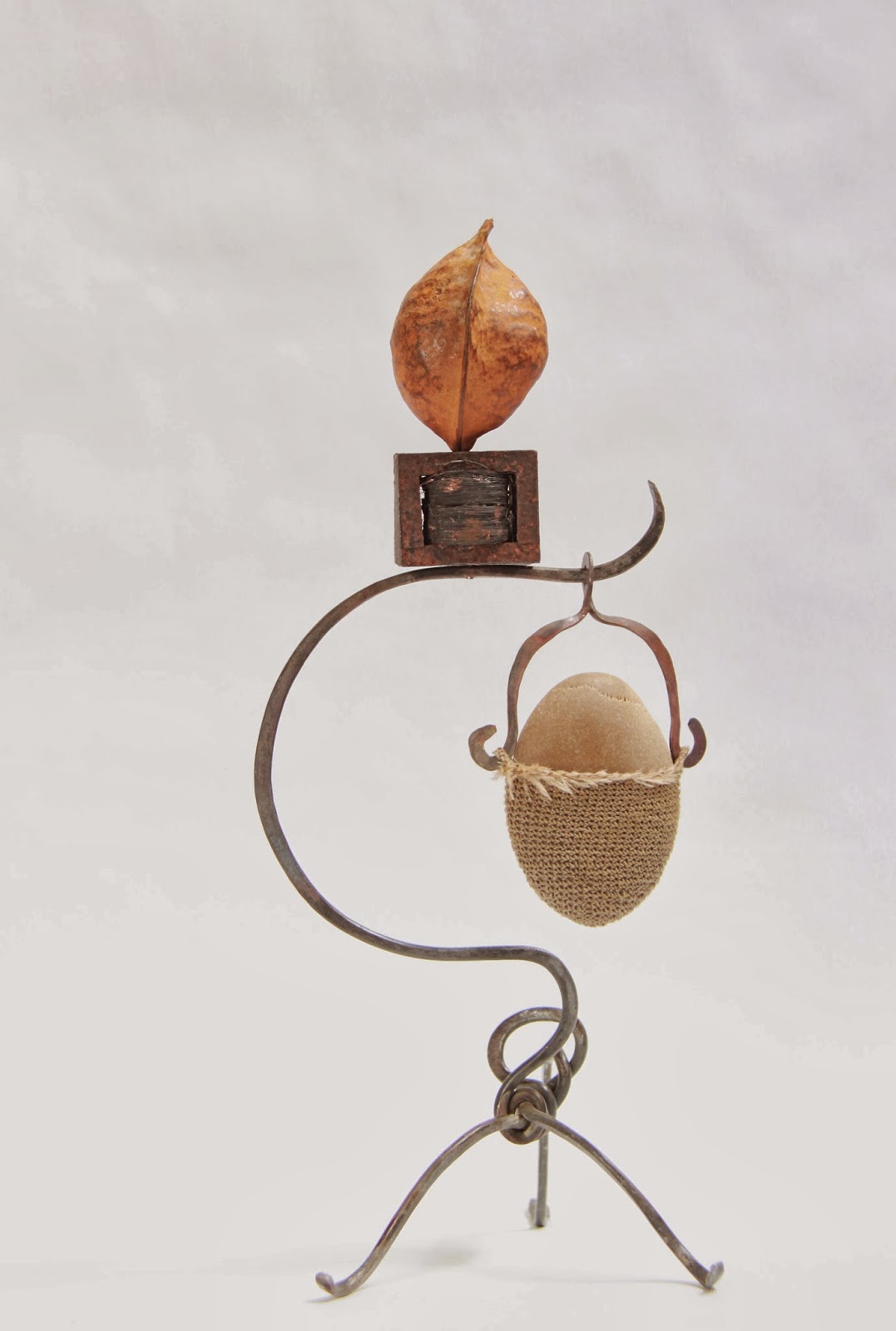
Stone, steel, copper, linen, seed.

Part 2. (minus linen, added cotton and wood)

Part 3.  (linen)

Part 4 (added gravity)


Part 5. (added silk and gravity)

Part 6.  (added gravity, old rail spike and sea urchin part)


Found objects, starting with stone and developing.


Wednesday, October 23, 2013

Biophilia at Goldsmiths

What to do when the gallery disappears.

There's a beaut little bed and breakfast, Goldsmith's in the Forest, just up the road from where I live.  I asked, they answered, and before I could blink I was installing Biophilia in the elegant dining room there.  I am so pleased that I did.  The work is perfectly fitted to the space; environmentally, spacially, philosophically, sympathetically.

Harmony on all sides.


Friday, May 31, 2013

Biophilia


Plants are the basis


for all the hoards that follow


and all that they make


Leafy, with flowers and fruits.


Monday, February 4, 2013

Apples


Apple power.......  it won't ever start my car, but it does run a tiny light.

Friday, February 1, 2013

Sproutings


Come into my Kitchen.  (f)route-ways, by-ways, old ways, never one-way, right ways at every turn.  Growing in glass, mouldering, stewing, sweating, seeping......  sprouting.  Every sprout is a possible pear, plum, persimmon.  Apples and innumerable bees. Waxing, waning, but mostly waxing.  Bees go roaming but always make a bee-line home.  Every possible bee-line is a right way. A right-of-way.

Thursday, January 17, 2013

Bee Lines


North, South, East, West.

Knowing these puts me at the centre, well earthed, wherever I am.  
Bees are very, very good at this.  And they are good at telling each other where they have been.  Body language of Bees.  We are surprisingly good at studying this, so we have a fair idea of how they tell the story of their latest luscious nectar find.  Dancing out the directions according to the position of the Sun.  A Sun Dance.


Friday, January 4, 2013

Impressions

Its the quiet places that stay with me.  Might be because that's where there is time and space to observe, secure in the feeling of being unobserved.


I have been trying to think of ways to record what is there with more that photographic images.  The textures, patterns and smells.  The gritty, prickle infestations and what grows around and about.  This beaut little home made press lets me emboss paper with the shapes of the flora, in a very small way.


Tiny impressions of shape and colour, linked with linen.


Wednesday, December 19, 2012

Time


The thing about Australia is distance.  If you have a car and the funds to fuel it, you can go anywhere.  Anywhere.  Drive for days and never speak to another soul.  Camp in splendid isolation and never see another vehicle.  It does wonders for clearing the head.


In a vast lanscape the small detail becomes the feature.  Dainty details.  Patterns of colour and form.  When my eyes tire of staring into the shimmering distance, its the cracks in the clay pan that hold my gaze.  


The clay.


Earth-shaped chards.
                                             
Sun-baked

                                                                                                             
Fired